船隻設計 Boats 101
River Runner 與 Creeker River Runner & Creeker
深入探討激流獨木舟的物理設計原理。解鎖船底翹度 (Rocker)、邊緣輪廓 (Edges)、船底形狀 (Hull Shape) 與浮力分佈 (Volume Distribution) 對划行運動表現的決定性影響。
An in-depth guide to whitewater kayak design physics. Understand how Rocker, Edges, Hull Shape, and Volume Distribution govern on-water paddling performance and safety.
前言:超脫行銷話術,理解物理設計 Introduction: Beyond the Marketing Hype
挑選獨木舟固然令人興奮,卻也常使划手無所適從。面對製造商琳瑯滿目的專利與行銷宣傳,關鍵在於理解船體設計的物理原理如何決定水上運動表現,進而挑選出最契合自身需求的船隻。 Buying a kayak involves a dizzying number of options and manufacturer claims. What's crucial is having a fundamental understanding of physical design factors and how they govern on-water performance, helping you choose the right kayak for your paddling needs.
Creeker 與 River Runner 的本質差異 Creek Boats vs. River Runners
以河道航行(而非花式玩水)為主的船隻可分為兩大類:Creekers 專為狹窄、陡峭且高技術難度的激流(Creeking)而設計;River Runners 則強調直線航速、精準切入迴流(Eddy)以及波浪衝浪的操控樂趣。兩者在物理特性上的差異可歸納為三個決定性要素:船底翹度 (Rocker)、邊緣與船底形狀 (Edges & Hull),以及浮力分佈 (Volume Distribution)。 Boats designed primarily for downriver paddling fall into two main categories: Creekers, engineered for tight, steep, and highly technical whitewater; and River Runners, focused on downstream speed, crisp eddy turns, and wave surfing fun. The physical differences between the two boil down to three core factors: Rocker, Edges & Hull Shapes, and Volume Distribution.
1. 船底翹度 (Rocker) 1. Rocker Profile & Dynamics
船底翹度是指船底向船頭與船尾上揚的弧度。它決定了有效吃水線、入水迎角與越障能力,並共同影響速度與靈活性的平衡。
Rocker refers to the upward curvature of the kayak hull toward bow and stern. It dictates effective waterline, angle of attack, obstacle clearance, and the balance between speed and maneuverability.
A. 翹度高度與有效吃水線 (Effective Waterline) A. Rocker Height & Effective Waterline
有效吃水線是指船底實際與水面接觸的長度,有別於船身長度。船頭與船尾的翹度越大幅度地上揚,有效吃水線就越短。 The effective waterline is the length of the hull actually in contact with the water, distinct from the total boat length. The more aggressively the bow and stern rock upward, the shorter the effective waterline becomes.
低翹度 (Low Rocker) 擁有較長的有效吃水線,水流能較平滑地通過船底,直行航速與航向保持性 (Tracking) 較佳,在突破巨浪或強烈倒捲流 (Hole) 時,較不易被側向水流推離既定航線。高翹度 (High Rocker) 除了縮短有效吃水線、提升轉向靈活度,也會改變船首入水姿態;因有效吃水線極短,直行前進時速度通常較慢,也較容易受到急流橫向干擾。 Low Rocker kayaks have longer effective waterlines, allowing water to flow smoothly along the hull for superior forward speed and tracking. They punch through large waves and retentive holes with less risk of being deflected off line. High Rocker kayaks shorten the waterline for rapid rotation and pivot maneuvering, but are noticeably slower in forward tracking and more susceptible to lateral cross-current interference.
物理迎角與越障能力 (Angle of Attack) Angle of Attack & Obstacle Clearance
船首 Rocker 的絕對高度,決定了船體切入水體的迎角。高 Rocker 類似越野車的高底盤進入角,使船首在遭遇強烈亂流、水洞 (Holes) 或岩石時,傾向於「騎越 (Ride over)」障礙物,而非「刺穿 (Pierce)」水流。這讓船體能利用水流的衝擊力將船身抬升,避免被水洞吸住或吞噬。 The absolute height of the bow rocker dictates the hull's entry angle of attack. Much like the approach angle on an off-road vehicle, a high rocker enables the bow to ride over turbulent currents, holes, and rocks rather than piercing through them. This allows the hull to utilize water impact forces to generate upward lift, preventing the boat from getting pinned or submerged in retentive holes.
B. 翹度起點:連續型 (Continuous) 與折角型 (Kick) B. Rocker Start: Continuous vs. Kick Rocker
翹度起點決定了船體如何將槳手的重心轉移轉化為動態反應。其幾何特徵可類比為搖椅底部的木弧條:一種是全段皆為圓潤弧線,另一種是僅在兩端折翹、中間保持平直。這項幾何設計也影響 Boofing(飛躍落差時保持船身水平貼水、維持速度並避開水底岩石)的平順效率。 The starting point of the rocker profile dictates how the kayak translates paddler weight shifts into dynamic motion. Visualize the wooden runners of a rocking chair: one with a smooth, continuous arc throughout, and another with a flat center and sharply upturned ends. This geometry heavily influences boofing efficiency (the technique of launching flat over drops to maintain speed and avoid submerged rocks).
連續型翹度 (Continuous Rocker) 自座艙下方即向兩端呈平滑弧線延伸。划手轉移重心時,能較流暢地抬升船頭,Boofing 表現佳,是 Creekers 應對陡峭落差的常見配置;但因底部缺乏平坦滑行面,在綠浪上衝浪的操控性較受限。 Continuous Rocker curves smoothly from beneath the cockpit all the way to both ends. Shifting weight backward seamlessly lifts the bow, providing exceptional boofing performance over steep drops—a staple design for creek boats. However, the lack of a flat planing surface limits wave surfing agility.
折角型翹度 (Kick Rocker) 在中間保留較長且平坦的滑行底面 (Planing Surface),僅在靠近船頭尾時陡峭上揚。直行航速與平水推進效率通常較好,扁平底盤在衝浪時也較靈活;但在複雜激流中 Boofing 的手感較生硬,缺乏連續弧度的流暢過渡。 Kick Rocker maintains a long, flat planing surface in the middle with abrupt kicks upward near the tips. This configuration yields higher hull speed on flatwater and excellent wave surfing responsiveness, though boofing in complex drops feels stiffer without the smooth transition of a continuous curve.
C. 翹度形狀:線性 (Linear) 與漸進式 (Progressive) C. Rocker Shape: Linear vs. Progressive Rocker
這項屬性決定了船隻在高落差(如瀑布、陡降)垂直落水時的流體動力學反饋,是守護划手人身安全的關鍵防線。 This property governs fluid dynamic feedback during vertical landings over steep waterfalls and drops, serving as a critical safety defense for the paddler.
線性翹度 (Linear Rocker) 的上揚曲線弧度保持均勻恆定(近似一條斜直線)。衝下垂直瀑布或陡降落差時,容許的入水安全夾角範圍較窄;若入水角度不夠平,船首不易獲得足夠抬升,船隻可能筆直插入深水(插水 Penciling),進而觸底卡岩或翻覆。 Linear Rocker maintains a constant slope (resembling a straight diagonal line). Over vertical waterfalls or drops, it provides a very narrow safe landing window. If the landing angle isn't flat enough, the bow fails to generate lift and can plunge vertically deep into the plunge pool (penciling), risking severe bottom impact or capsize.
漸進式翹度 (Progressive Rocker) 在船頭與船尾端部急遽上揚,入水安全夾角的容錯率較寬;即使 Boofing 角度不完美,也較不易插水。大弧度端部類似水翼 (Hydrofoil),能把撞擊水流向下排開並產生向上反作用力,協助船首快速回復並轉為水平滑行,脫離具回吸力的倒捲流 (Hole),同時吸收垂直落水衝擊,降低對脊椎的傷害風險。 Progressive Rocker curves upward much more aggressively near the tips, offering a wide margin of landing error. Even on imperfect boof angles, the hydrofoil-like tip deflects landing water downward and generates upward lift. This rapidly surfaces the bow into horizontal planing speed to escape retentive holes while absorbing vertical landing shock to protect the paddler's spine.
2. 船底與邊緣 (Hull & Edges) 2. Hull Profiles & Edge Carving
邊緣輪廓(Edges)與船底形狀(Hull Shapes)共同決定了船體壓邊切行(Carving)的動態咬水反饋,以及在亂流岩石間擦岩滑行(Smear)的容錯性。
Chine edge profiles and hull geometries define how the kayak interacts with moving cross-currents, balancing carving aggressiveness and smearing forgiveness.
三大核心船底與邊緣範例解析 Three Core Hull & Edge Configurations Explained
硬邊 + 滑行型船底 Hard Edge + Planing Hull
物理設計:底盤扁平,側壁與平底相交處呈銳利硬折角稜線 (Hard Chine)。動態表現:船體側傾時,稜線類似龍骨線,能抵抗側向水流引起的自旋,維持直行或穩定軌跡;壓邊切行 (Carving) 反應犀利,切入或切出迴流 (Eddy) 時手感明確。缺點是稜線較易在沸水 (Boil) 咬邊 (Edge Catch),岩石間也較易卡阻,常見於 River Runner。 Physical Design: Flat bottom meeting vertical sidewalls at a sharp corner (Hard Chine). Performance: When tilted, the edge acts like a keel, resisting spinning from lateral currents and carving precise arcs into eddies. The trade-off is vulnerability to catching edges in turbulent boil lines and hanging up on shallow rocks. Highly typical on River Runners.
軟邊 + 排水型船底 Soft Edge + Displacement Hull
物理設計:橫剖面呈圓弧或蛋形,側壁向底部平滑過渡 (Soft Chine)。動態表現:前航阻力小、二次穩定性佳;從 15 英尺(約 4.5 公尺)以上落差水平入水時,圓潤船底能分散衝擊。岩石間穿行流暢、沸水區較不易咬邊,利於擦岩滑行 (Slide/Smear);但 Carving 咬水感較弱,衝浪與切入迴流的反饋也較模糊。 Physical Design: Rounded, egg-shaped cross section with smooth transitions into the sidewalls (Soft Chine). Performance: Low water resistance, high secondary stability, and effective shock dissipation on 15+ ft vertical drops. Glides smoothly over rocks and resists catching in boils, facilitating rock smears. However, carving traction is softer, making eddy turns less snappy.
軟邊 + 滑行型船底 Soft Edge + Planing Hull
物理設計:船底中央保持扁平滑行面,兩側稜線修圓平滑過渡。動態表現:這是 Creeker 與 River Runner 常見的折衷設計,保留 Planing Hull 的加速性;Boofing 入水後也較易 plane away。軟邊在 Slide、Airplane Boof 與沸水區具較佳容錯與安全性。 Physical Design: Flat planing center with softened, rounded chines along the sides. Performance: The modern benchmark for Creekers and hybrid River Runners. Delivers the rapid acceleration of a planing hull to plane away after boofs, combined with the rock-smearing forgiveness and boil safety of soft edges.
3. 浮力分佈 (Volume Distribution) 3. Volume Distribution & Buoyancy
容積分佈是指沿船身長度方向的各截面容積分配比例。這決定了船體潛入水下後重返水面的爆發力、穩定性,以及抵抗回捲水流(Hole)向下吸壓的能力。
Volume distribution represents the cross-sectional buoyancy allocation along the kayak. It governs resurfacing explosiveness, stabilization, and resistance against tail-grabs in retentive holes.
中置容積 River Runner Centralized volume · River Runner
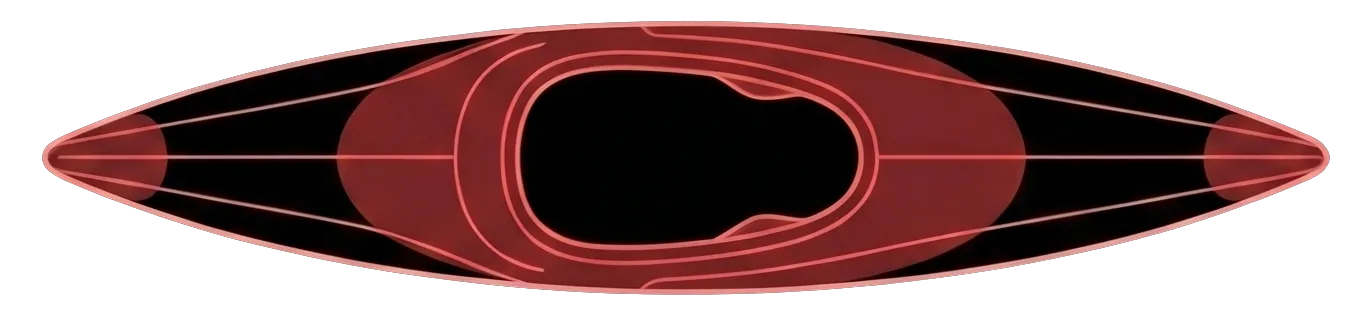
TOP DOWN VIEW
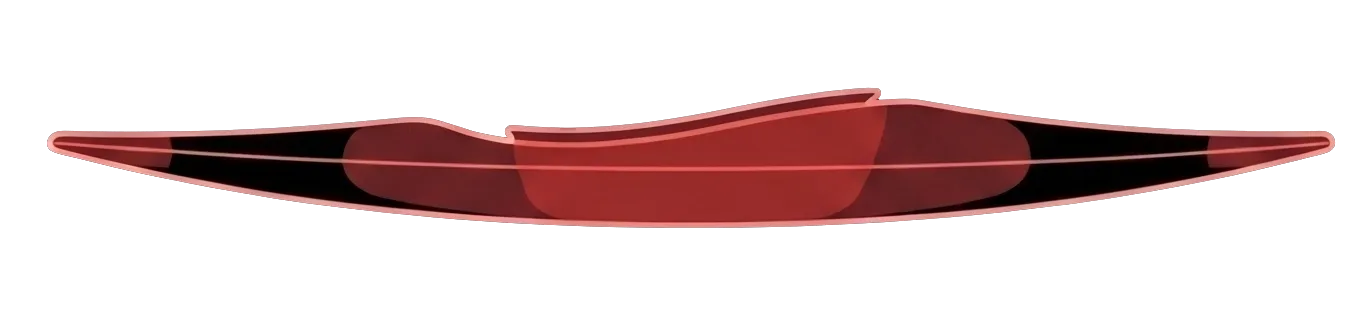
PROFILE VIEW
端部分佈容積 Creeker End-distributed volume · Creeker
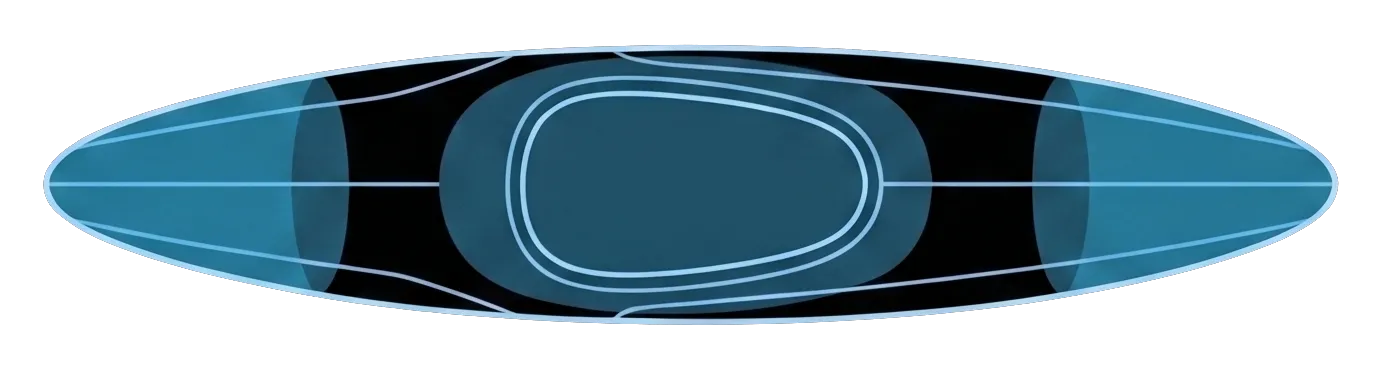
TOP DOWN VIEW
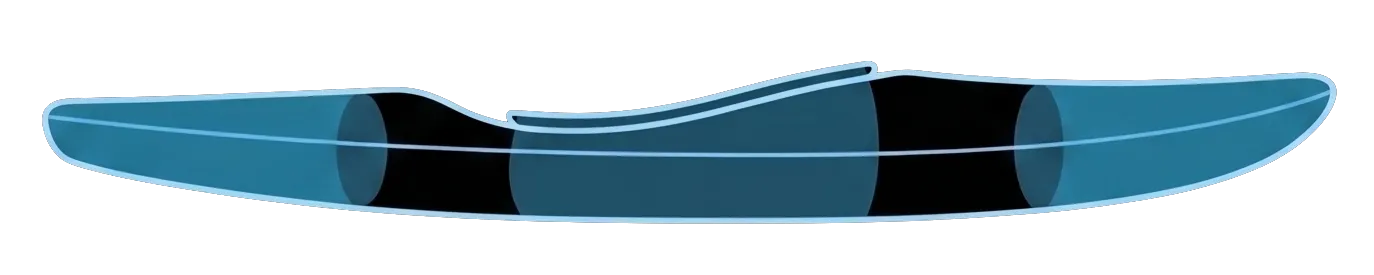
PROFILE VIEW
容積分配的力學影響 Mechanical Impact of Volume Distribution
中置容積 (River Runner 特徵):容積集中於座艙 (Cockpit) 周圍,並朝船頭與船尾急劇收窄。這能降低轉動慣性 (Rotational Inertia),使兩端較易切入水流,運動感更靈巧。薄扁船尾也利於壓尾翻轉 (Stern Squirt) 等動作,衝浪時端部質量較輕,旋轉與操控更靈活。 Centralized Volume (River Runner profile): Volume is concentrated around the cockpit and tapers sharply toward bow and stern. This lowers rotational inertia, allowing the ends to slice through water for an agile, playful feel. The slim stern enables technical maneuvers like stern squirts and makes pivot turns effortless when wave surfing.
端部分佈容積 (Creeker 特徵):船頭與船尾配置厚實、飽滿的儲備浮力。轉向慣性會增加,但在陡落差或落水時,重返水面起浮力 (Resurfacing Force) 較強。飽滿船頭較不易在倒捲流 (Hole) 埋頭,傾向於 ride over holes 而非被吞噬;飽滿船尾也能降低尾部被回捲水流吸住、發生後傾立艙翻船 (Backender) 的風險。 End-Distributed Volume (Creeker profile): Generous reserve buoyancy is packed into bulbous bow and stern sections. While rotational inertia increases, resurfacing force after drops is explosive and controlled. The high-volume bow rides over holes rather than getting swallowed, and the bulbous stern prevents the dangerous 'backender' flips caused by retentive backwash grabbing low-volume tails.
總結評估原則 Paddler's Summary & Checklist
世界上不存在能完美勝任所有環境的獨木舟。每一款設計都是物理性能的妥協與取捨。掌握這些物理常識,是避開製造商行銷陷阱的唯一捷徑。
No single kayak excels at everything. Every hull design is a trade-off in physics. Mastering these principles is the surest way to look past marketing hype and choose the right boat.
直行速度優先型 Speed & Tracking Focus
- 選用低翹度 (Low Rocker) 以拉長有效吃水 Low Rocker for maximum effective waterline
- 選用圓弧排水型船底 (Displacement Hull) Displacement Hull for smooth hydrodynamic flow
- 選用硬折角稜線 (Hard Edge) 以利壓邊切行 Hard Edges for aggressive carved tracking
陡峭激流安全優先型 Steep Creeking & Safety Focus
- 選用連續性翹度 (Continuous Rocker) Continuous Rocker for predictable boofing
- 選用漸進式船頭弧度 (Progressive Rocker) Progressive Rocker to prevent penciling on drops
- 選用圓滑軟邊 (Soft Edge) 增加滑岩容錯 Soft Edges for rocky smears and boil-line safety
- 選用高浮力端部 (Distributed Volume) 促進起浮 Distributed Volume for explosive resurfacing
衝浪花式玩水優先型 Play & Wave Surfing Focus
- 選用折角型翹度 (Kick Rocker) Kick Rocker for flatwater speed and wave release
- 選用扁平滑行型船底 (Planing Hull) Planing Hull for dynamic wave surfing
- 選用中置容積,使端部薄扁利於切水 Centralized Volume with sliced ends for squirts
權威聲明與專業翻譯認證 EEAT Authority & Translation Attestation
本船隻物理設計理論編譯自全球極具公信力之極限裝備評測平台 Blister Review 發表之權威指南 Boats 101: River Runners and Creek Boats (作者:Thomas Neilson,發表於 2013 年 5 月 21 日)。本編譯版本已針對中文標準術語與雙語對照進行本土化校訂,致力於推廣國內安全且具科學素養的激流划行教育。 This theoretical guide on kayak design physics is compiled and translated from the authoritative guide Boats 101: River Runners and Creek Boats by Thomas Neilson (published May 21, 2013) on Blister Review. This bilingual edition provides standardized nomenclature and localized adjustments to advance scientific and safe whitewater education in Taiwan.
如需針對特定的實體獨木舟品牌(如 Jackson Kayak, LiquidLogic, Dagger, Pyranha 等)進行排水量、寬度與長度數值比對,請前往 激流獨木舟規格資料庫 (Boat Specs) 檢索。 For direct comparisons of displacement, width, length, and specs across kayak brands (such as Jackson Kayak, LiquidLogic, Dagger, Pyranha, etc.), visit the Whitewater Kayak Specs Database.